Ulcers and Wounds
REGENERATIVE TREATMENT FOR ULCERS AND WOUNDS IN LONDON
With a proven track record in regenerative medicine, you’re in safe hands.
Many people suffer from chronic ulcers or wounds that do not heal and hence can cause them problems for the rest of their life. This not only greatly impacts on their wellbeing, but may also make them susceptible to other illnesses and infections such as such pneumonia, or hypertension and heart disease. Diabetic foot ulcers can also be prone to gangrene.
Treatment for ulcers and wounds can vary from person to person to person depending on their condition, but may include antibiotics to fight infection or other medications to promote healing. In some cases, amputation may be required. However, research suggests that stem cell therapy also has great potential to heal wounds.
Stem cell treatment is a relatively new discipline of regenerative medicine. Where there is an established medical need, a clinician may now prescribe stem cell therapy as a treatment within the UK, in accordance with regulation by the Human Tissue Authority.

DR KHAN SAYS
“Regenerative treatments are an option for people who may have already tried, or considered, conventional treatments. Research using stem cells with latest technology has shown promising results.”
DR TEE SAYS
Stem cells are located throughout the body and act as natural healers. Studies suggest that when used for medical purposes, stem cells have the potential to accelerate tissue repair, stimulate tissue regeneration, and decrease inflammation.
ULCERS, WOUNDS AND STEM CELL RESEARCH
Chronic wounds, including burns and diabetic ulcers, cause misery for the patient and place a burden on the health care system, which must devote significant resources to dressings and to treating associated illnesses. It is estimated that the annual cost of managing wounds is around £5.3billion in England alone, and this does not take into account social and economic costs.
Stem cell therapy and related regenerative treatments such as stromal vascular fraction (SVF) and platelet rich plasma (PRP) aim to boost the body’s natural ability to heal. A study published in 2019 concluded: “Various procedures have been employed in the treatment of skin ulcers among which cell-based therapy, particularly adult stem cell, has emerged as a promising treatment to promote scar-less wound healing.” [1 & 2]
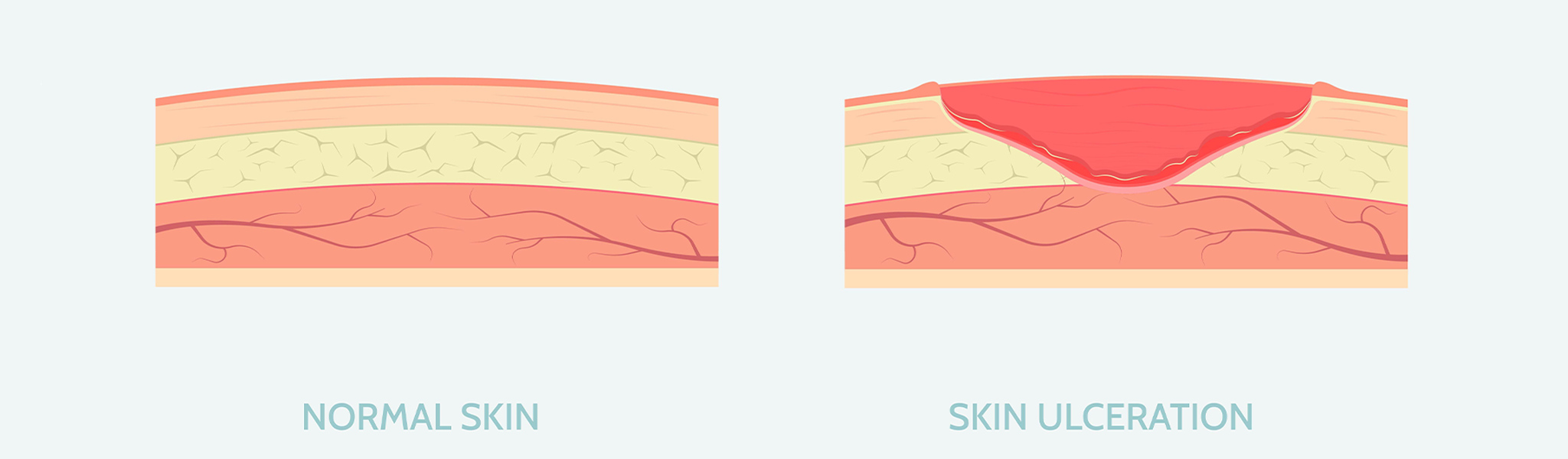
Stem cells have the power to change through a process called differentiation into various types of cells that perform important functions in the healing process. This includes the ability to repair or regenerate damaged tissue, increase the supply of blood, and settle inflammation. Hence, studies are underway to further assess the benefits of stem cell therapy and related treatments.
For example, regenerative cells within SVF (a biological treatment refined from a sample of the patient’s own fat tissue or skin) can recognise distress signals from damaged tissue and will start to replicate. They also send out messages to other cells in the skin on the edges of a wound, which causes them to grow and multiply.
Similarly, PRP (which is refined from a patient’s own blood) has also been shown deliver results. A study published in 2018 concluded: “PRP is a powerful tool for the treatment of chronic wounds and very promising for diabetic foot wounds as it enables healing, and reduces amputation rates, infection and exudates.” [3]


WHAT ARE STEM CELLS?
Stem cells are special types of cell that occur naturally within the body. They have the ability to replicate themselves or develop into different types of cells through a process known as differentiation.
Hence stem cells have the potential to become new cells in order to perform specific functions. For example, they can differentiate to become blood cells or other types of cell that are active within the immune system. This process enables stem cells not only to play a unique role in the body’s ability to heal itself, but also to encourage the growth of healthy tissue.
HOW ARE STEM CELLS USED IN MEDICINE?
Whilst stem cell therapy is relatively new, stem cells have been the subject of over 40 years of research and there have been a large number of clinical trails. A limited number of treatments for certain medical conditions are now available in the UK.
When used for medical purposes, research suggests stem cells can accelerate tissue repair, stimulate tissue regeneration, decrease inflammation, and stimulate new blood vessel growth.
WHAT TREATMENTS ARE THERE FOR CHRONIC WOUNDS, BURNS AND DIABETIC ULCERS?
There are number of existing treatments for to promote healing, w which your doctor can advise you upon. These can include medications to fight infection, topical steroids, and in some cases reconstructive surgery.
However, those patients seeking alternatives to established approaches may be able to benefit from regenerative therapies such as stem cells, SVF or PRP, where appropriate.
For example, a study into the use of PRP concluded: “There have been considerable advances in the use of PRP in therapeutic processes in recent years in tissue regeneration therapy.” [3]
CAN I HAVE STEM CELL THERAPY?
Stem cell therapy may be considered for people who require an alternative approach to established procedures. It may be suitable for patients aged 18 to 75 or children in special circumstances, whose condition is stable enough to undergo treatment.
The first stage is to book a consultation with a qualified medical practitioner, who will assess your medical history in order to potentially make a pre-approval application. A multi-disciplinary panel of experts will then consider your application.
If you application is approved, you will then be invited undergo a full health screening and detailed tests to ensure stem cell treatment is an appropriate approach for you. Provided you pass the assessment criteria, you may then begin treatment.
WHAT DOES TREATMENT INVOLVE?
Patients generally require a preparation period that may involve a number of procedures to ensure your regenerative system is at its most receptive. The stem cells can typically then be injected into the body, which depending on the nature of your condition can either be done by intra-tissue injection.
WHERE DO THE STEM CELLS COME FROM?
The stem cells may be either ‘autologous’ or ‘allogeneic’. Autologous stem cells are processed after being harvested from tissue from the patient’s own body, whereas allogeneic stem cells are cultured in a laboratory from a donated source. In our clinics we only use ‘Autologous’ tissue- derived cells. ‘Allogeneic’ cells are currently used for research purposes, or by the NHS for bone marrow transplantation.
HOW ARE STEM CELLS REGULATED?
Stem cell therapies are classed as nouvelle treatments or ‘specials’, which are a permissible category of medicines that are available to meet the clinical needs of an individual patient.
The progress of stem cell patients is carefully monitored and the treating team have a regulatory duty to report any relevant findings to the responsible research NHS Body, with a view to stem cell therapy becoming a standardised licensed treatment in the future.
Can’t find the answer you’re looking for?
Click here to ask us your question.
ABOUT DR KHAN AND DR TEE
The Cellular & Regenerative practice in Harley Street was co-founded by Dr Aamer Khan, author of the forthcoming book, ‘Aesthetic Treatments in Regenerative Medicine: Stem Cells, Stromal Vascular Fraction, Platelet Rich Plasma, and Platelet Rich Fibrin.’
Dr Aamer Khan
Qualifying as a Doctor at the University of Birmingham in 1986 with an MB ChB (Bachelor of Medicine, Bachelor of Surgery), Dr Khan completed his postgraduate training in University Hospitals Birmingham. He spent 24 years working within the NHS, including many years in General Practice in a community with the largest proportion of elderly population in the UK. This led to his passion to study cellular and regenerative medicine, and develop an integrative approach to his medical practice.
As part of his cellular and regenerative interest, Dr. Khan’s Clinic, was one of the first to work with Cytori Stem Cell Technologies in 2008. In 2010, he retired from the NHS to refine protocols at the Harley Street Skin Clinic, and develop his integrative medical practice and the Cellular + Regenerative clinic.
Dr Mike Tee
Dr Mike Tee MB, BChir, BSc (Hons), DLO, DRCOG, MRCGP, is a Cambridge medical graduate, and has over 25 years of experience in the medical profession. Dr Tee is well regarded as an expert in Dermal Fillers, PRP, Thread Lifts, Mole Removal & dermatological minor surgery. Dr. Tee has worked very closely with Dr. Khan and developed a wealth of knowledge and expertise in integrative and regenerative medicine.

Sources
1 – NHS: – Betty’s story leg ulcer wound care
england.nhs.uk/rightcare/wp-content/uploads/sites/40/2017/01/nhs-rightcare-bettys-story-narrative-full.pdf
2 – Nourian Dehkordi, A., Mirahmadi Babaheydari, F., Chehelgerdi, M. et al. Skin tissue engineering: wound healing based on stem-cell-based therapeutic strategies. Stem Cell Res Ther 10, 111 (2019).
https://doi.org/10.1186/s13287-019-1212-2
https://stemcellres.biomedcentral.com/articles/10.1186/s13287-019-1212-2
3 – Prakasam, N et al (2018) A clinical study of platelet rich plasma versus conventional dressing in management of diabetic foot ulcers. International Surgery Journal doi.org/10.18203/2349-2902.isj20184069
https://www.ijsurgery.com/index.php/isj/article/view/3384